





Footage shows male senior swiftly strike ball in attempt to make goal, inadvertently hitting female player directly in mouth. A female high school lacrosse player [more…]

NOTE: For Blaze News senior editor Dave Urbanski’s response to this piece, click here.
A new Led Zeppelin documentary hits theaters this Friday, ready to remind everyone why the group is still one of rock’s greatest bands.
It’s all there —Jimmy Page’s searing riffs, Robert Plant’s ethereal vocals, John Paul Jones’ masterful grooves, and John Bonham’s thunderous drums — bursting from IMAX screens with the energy that made Zeppelin legendary.
The music industry is littered with examples of artists walking a fine line between inspiration and outright theft, often stepping well over it.
But even as the film celebrates Led Zeppelin’s glory, an old question refuses to die: How much of that brilliance was theirs to begin with?
The accusations are hardly new. The band’s most iconic song, “Stairway to Heaven,” has been embroiled in controversy for decades, accused of lifting its opening riff from Spirit’s “Taurus.” The similarities are impossible to ignore. Honestly, you’d have to be tone-deaf — or actually deaf — not to notice the unmistakable descending acoustic progression that led to a courtroom battle.
Zeppelin may have won the case, but it reopened long-standing questions about the band’s creative process.
Take “Dazed and Confused,” one of Zeppelin’s early classics, which for years was considered an original until folk singer Jake Holmes revealed that it was nearly identical to his 1967 song. Then there’s “Whole Lotta Love,” with its iconic intro and trippy breakdown, which lifted heavily from Willie Dixon’s “You Need Love.” Dixon eventually got credit — but only after suing the band.
The question is not whether Zeppelin borrowed. They did. The real question is whether that borrowing diminishes their genius.
Zeppelin had an extraordinary gift for taking raw material and turning it into something monumental. The band didn’t just cover songs; they transformed them. The band — anchored by the holy (or unholy) trinity of Page, Plant, and Bonham — channeled an energy that felt almost otherworldly. But, I ask, does that kind of transformation make the appropriation any less problematic?
Zeppelin’s defenders often point to the folk and blues traditions the band drew from, where borrowing was not only common but celebrated.
The blues, in particular, is a genre built on shared motifs and communal storytelling. But there’s a point at which paying homage becomes exploitation. Zeppelin, with their stadium tours and gold records, profited handsomely from work that less commercially successful artists had labored over, often without giving credit until lawsuits forced their hand.
Of course, the problem of appropriation isn’t unique to Zeppelin. The music industry is littered with examples of artists walking a fine line between inspiration and outright theft, often stepping well over it.
Take the Beach Boys’ “Surfin’ U.S.A.,” a cheerful anthem that’s almost a carbon copy of Chuck Berry’s “Sweet Little Sixteen.” Berry’s lawyers didn’t waste any time, making sure he got the credit — and the cash — he deserved.
Elvis Presley, the so-called “King of Rock and Roll,” was perhaps the most blatant example of appropriation in his era. His charisma and voice were undeniable, but many of his biggest hits leaned heavily on the work of black artists whose contributions to rock and blues had been overlooked or outright dismissed by mainstream audiences.
“Hound Dog,” for instance, was a smash hit for Elvis but had already been made famous by blues singer Big Mama Thornton. Like so many of her peers, Thornton received neither the recognition nor the financial rewards that Elvis enjoyed.
One needn’t be a DEI-endorsing, reparations-demanding white-privilege protester to see the problem here. Elvis may have had the swagger and the gyrating hips, but much of his success was built on a foundation laid by others.
Fast-forward to the 1990s, and you find Vanilla Ice unapologetically lifting the bass line from Queen and David Bowie’s “Under Pressure” for “Ice Ice Baby,” a move so shameless that it’s become a textbook case of musical theft. More recently, Pharrell Williams and Robin Thicke’s “Blurred Lines” made headlines after the duo crossed a line of their own. A court ruled that the track was too similar to Marvin Gaye’s “Got to Give It Up,” hitting the artists with millions in damages. It was the correct decision.
Today, of course, we live in an era of sampling, remixing, and infinite digital archives. Kanye West, a self-proclaimed genius, has built entire albums on samples from soul, gospel, and electronic music. Set aside his very public meltdowns, and his work has often demonstrated a profound talent for reshaping snippets of the old into something entirely new. Is that really so different from what Plant and his pals were doing decades earlier?
This raises a bigger, more philosophical question: If the final product is extraordinary, does it really matter where it came from? Does the brilliance of “Stairway to Heaven” lose its magic because its opening riff traces back to Spirit? Can the raw power of “Whole Lotta Love” be dulled by its roots in a Willie Dixon song?
At what point does the craft rise above the criticism? If the output surpasses the original, if it elevates the material to something greater, then maybe the borrowing is justified.
Then again, maybe not.
Perhaps the answer lies in how we define genius. Is it purely the ability to conjure something from nothing, or is it the capacity to take fragments of the past and reshape them into something immortal? Zeppelin’s genius was not in their originality but in their alchemy — the way they fused blues, folk, and rock into a sound that defined a generation.
For millions of people, including some who might be reading this, Zeppelin’s songs are more than just pieces of music. They’re sacred anthems, timeless masterpieces. Ultimately, their power isn’t in where they came from but in how they make you feel, how they transport you, how they tap into something deep, even primal. And maybe that’s what truly defines great art: its ability to endure, to move, to inspire, and, in the case of Zeppelin, to spark endless controversy.
Led zeppelin, Plagiarism, Whole lotta love, John mac ghlionn, Blues, Movies, Rock, Culture
NOTE: This article responds to John Mac Ghlionn’s “Rock gods or riff thieves?” which you can read here.
For all the plagiarism accusations against Led Zeppelin — and many are valid — the vast majority of the band’s greatest songs are truly original.
“Kashmir.” “Ten Years Gone.” “In the Light.” “Ramble On.” “Good Times Bad Times.” “Heartbreaker.” “What Is and What Should Never Be.” “Black Dog.” “Rock and Roll.” “Celebration Day.” “The Song Remains the Same.” “The Rain Song.” “No Quarter.” “Dancing Days.” “Over the Hills and Far Away.” “Immigrant Song.” “The Ocean.” “Trampled Under Foot.” “Achilles Last Stand.” “In the Evening.” “Fool in the Rain.” So many.
Did Spirit borrow from Davey Graham for ‘Taurus’? As Page and Plant testified, memories of that time tend to be a little fuzzy.
What’s more, the ones they nicked are far superior to the originals for the most part. It’s too bad, really, because the band could have leaned into their obvious skills and creativity a bit more and avoided the lion’s share of plagiarism chatter, but they didn’t — mostly in the first several years of their existence.
Why? Who knows. Record company pressure, deadlines. It’s an old story. Plus, they paid for it with lawsuits filed by a few of the original artists, and rightfully so.
A YouTuber has made a three-part series examining these plagiarism accusations in depth, and they’re pretty eye-opening.
Is the band guilty? For the most part, I would say yes. But as I noted previously, listening to Led Zeppelin tunes back-to-back with the original recordings only underscores how much better Zeppelin’s versions are, for the most part. That speaks to the band’s enduring talent and ability to create musical magic, both in the studio and onstage.
In addition, some plagiarism charges against Zeppelin are fairly nuanced.
For instance, when the band recorded “Whole Lotta Love,” the music was quite original, and singer Robert Plant was at fault only for lifting Wille Dixon’s “You Need Love” lyrics. Guitarist and elder statesman of the group Jimmy Page would have known the words to this future worldwide hit were plagiarized but apparently didn’t step in.
However, while Dixon sued Zeppelin in 1985, it wasn’t the first time Dixon’s “You Need Love” was copied. Long before Zeppelin committed their sophomore album to tape, Small Faces (and singer Steve Marriott) recorded “You Need Loving” — a blatant Willie Dixon “You Need Love” rip-off.
Not only that, a cursory listen to the Small Faces version makes it pretty clear that Plant copied Marriott’s vocal delivery for “Whole Lotta Love.” But Dixon didn’t sue Small Faces; he sued Zeppelin, even though Zeppelin weren’t the first offenders. I guess that’s understandable, as Zeppelin had far deeper pockets.
And a final word on “Stairway to Heaven” — a song, by the way, that a 2016 court decision (upheld in 2020) ruled Led Zeppelin hadn’t plagiarized.
As with “Whole Lotta Love,” Zeppelin is not the only would-be culprit. How many music fans out there know that British guitarist Davey Graham wrote a tune predating both “Stairway to Heaven” and “Taurus” called “Cry Me a River” — a song that contains a similar descending acoustic guitar figure?
Did Spirit borrow from Davey Graham for “Taurus”? As Page and Plant testified, memories of that time tend to be a little fuzzy.
Finally, consider the “evidence” compiled by a Dutch TV show demonstrating how prevalent the main riff of “Stairway to Heaven” has been in popular music over the years.
You be the judge.
Led zeppelin, Music, Rock, Blues, Dave urbanski, Entertainment, Culture, Plagiarism
“If you go to an extreme, and you become a boutique kind of proposition, then you’re going to lose the argument, and we have done [more…]
“I don’t know that much about it, but I’ve never read good things,” he says.
The much-anticipated merger between Nissan and Honda is off!
That’s the word from Japan’s Nikkei business daily, which reported that Nissan has decided to withdraw from its memorandum of understanding with rival Honda on pursuing a merger under a holding company.
If the Trump administration reduces or abolishes the EV mandate — and if Europe follows suit — Nissan and every other gas-powered carmaker will effectively get a bailout.
The behemoth resulting from that merger was set to become the world’s third-biggest automaker by sales. With that apparently off the table, observers now wonder how Nissan will drive its turnaround by itself.
And make no mistake — Nissan (Japan’s third-largest carmaker, just behind Honda) needs a turnaround.
The market is tough in general, with pressure from China’s BYD as well as other EV entrants. And Nissan has been hit harder than most in its overcommitment to EVs. Moreover, it still hasn’t quite fully recovered after the scandal of the arrest and removal of former Chairman Carlos Ghosn in 2018.
Nissan also finds itself particularly vulnerable to the threat of potential tariffs from U.S. President Donald Trump. Tariffs against Mexico would be more painful for Nissan than for Honda or Toyota, according to analysts.
So why did the deal fall apart? Insiders suggest it comes down to one word: control.
The deal would have made Nissan a subsidiary of Honda, which caused Nissan to balk.
For its part, Honda (with a market value nearly five times bigger than Nissan’s) saw it as the only reasonable arrangement.
Christopher Richter, senior Japan auto analyst at brokerage CLSA, commented on the situation: “The news saying that Nissan did not want to be a Honda subsidiary appears to highlight that control was a contentious issue. … Without being able to have control, Honda appears to be walking away.”
Honda was also increasingly worried about its smaller rival’s progress on the turnaround plan, per insiders.
Nissan is in the process of cutting 9,000 employees and 20% of global capacity.
What next?
If the Trump administration reduces or abolishes the EV mandate — and if Europe follows suit — Nissan and every other gas-powered carmaker will effectively get a bailout.
Nissan is 36% owned by French carmaker Renault SA, which in late January sent representatives to Japan to express concern over the transaction and seek a premium for its stake, according to some insiders.
Mitsubishi Motors Corp., which has reportedly decided against joining the alliance, said earlier this week it would make a final decision once Honda and Nissan reach an agreement later this month.
Honda’s shares jumped more than 8% on the news, while Nissan’s fell nearly 5%. Renault’s stock fell 3.4%.
Now the question is, what will happen with Nissan? It’s in a downward spiral, and there are hungry investors, like Foxconn, that want to take an ownership position in the company. In other words, this story is far from over.
Lauren fix, Evs, Auto industry, Toyota, Honda, Mistubishi, Nissan, Donald trump, Lifestyle, Align cars
Less than a month into his second term, President Trump has already resumed his aggressive foreign policy, best summed up by a simple mantra: FAFO — “f**k around and find out.”
This phrase, which became the unofficial guiding principle of Trump’s first administration, continues to shape his global strategy. His early move, threatening new tariffs on Canada, Mexico, and China, reinforces this approach.
America is back, with an aggressive foreign policy.
While the slogan may sound irreverent, it reflects a deliberate and forceful shift in U.S. foreign policy.
At the core of FAFO is a dramatic departure from the traditional diplomatic norms that have long defined America’s global posture. Under Trump, the United States has taken a hard line with both allies and adversaries, embracing an “America First” approach.
Trump has made it clear: America will no longer accept lopsided trade deals or unfair international agreements. And he is not afraid to wield economic power to ensure that the nation’s interests come first on the world stage.
What does FAFO mean in the context of foreign diplomacy? It’s about making bold moves without hesitation, challenging long-standing alliances, and demanding that other nations either step up to the plate or face consequences. For some, this was seen as reckless; for others, it was a refreshing change of pace after years of what they considered ineffectual or appeasing policies.
One of the clearest examples of Trump’s FAFO doctrine in action was his approach to NATO during his first term. Traditionally, the United States had served as the alliance’s primary protector and financial backer. Trump, however, demanded that European nations significantly increase their defense spending, making it clear that the U.S. would no longer be NATO’s “sugar daddy.” If allies refused to pay their fair share, they would face the consequences.
This was not just rhetoric — it was the foundation of Trump’s foreign policy.
His trade policies took a similarly aggressive stance, particularly against China. Instead of continuing the traditional path of diplomatic negotiations and trade concessions, Trump imposed tariffs, accused Beijing of unfair trade practices, and directly challenged China’s growing global influence.
In Trump’s view, the U.S. had been “playing nice” for too long while China exploited the system. His administration saw no reason to continue being accommodating — and made sure China felt the pressure.
That strategy remains in effect. On Feb. 2, Trump announced new tariffs on China, Canada, and Mexico — not to start a trade war, as many media outlets falsely claimed, but to pressure these countries into taking action to curb the flow of illegal drugs, especially fentanyl, into the United States.
Would the gambit work?
On Feb. 3, Mexican President Claudia Sheinbaum announced the immediate deployment of 10,000 troops to the U.S.-Mexico border. Canadian Prime Minister Justin Trudeau made a similar announcement later that same day. In response, Trump agreed to delay the tariffs on Mexico and Canada for one month.
Beyond Mexico and Canada, Trump has already scored several major foreign policy victories during his second term — each rooted in his FAFO strategy.
Colombia has agreed to accept flights of repatriated citizens who entered the United States illegally after first refusing to accept them. The change? Again, Trump threatened tariffs. Colombia capitulated and is accepting its citizens back into the country.
Venezuela freed six Americans who were being held illegally in the country after a very brief meeting with U.S. special envoy Richard Grenell. Venezuela has also agreed to accept the repatriation of its citizens illegally in the United States, including members of the brutal Venezuelan gang Tren de Aragua.
Trump also decided to take out several leaders of ISIS in Somalia last weekend, launching airstrikes.
And, just for good measure, newly confirmed Secretary of State Marco Rubio secured a commitment from Panama to withdraw from China’s Belt and Road Initiative and to maintain its sovereignty over the Panama Canal.
America is back, with an aggressive foreign policy. For those countries that do not believe it or want to challenge the new approach, Trump has shown that he has one thing to say: FAFO.
Donald trump, Fafo, Foreign policy, Mexico, Canada, China, Tariffs, Nato, Xi jinping, Claudia sheinbaum pardo, Justin trudeau, Richard grenell, Venezuela, Tren de aragua, Panama canal, Marco rubio, Opinion & analysis
It’s been an exciting week, as Elon Musk and the DOGE have exposed the United States Agency for International Development for wasting our tax dollars on the most far-leftist, anti-American, and just outright stupid causes.
While the American public at large is just now learning that USAID has been squandering our hard-earned money by the billions on dangerous and laughable causes alike, Glenn Beck has been sounding the alarm on USAID for years.
“USAID, as we have always told you, is an arm of the CIA. Anything that is too risky to do that you just don’t want to do in the CIA because somebody’s paying attention, you do it at USAID,” he says.
“All the color revolutions that happened all around the world, they were done by us. The Arab Spring was done by us. … It was USAID,” he adds.
While the mainstream media are working overtime to write off every shocking revelation as a conspiracy theory and spin a narrative of Trump cruelty, their claims are easily debunked with receipts, which, thanks to the DOGE, we now have in abundance.
Glenn reads some of the most shocking evidence of USAID’s prodigal spending.
“$7.9 million to teach Sri Lankan journalists how to avoid binary gendered language”
“$4.5 million to combat disinformation in Kazakhstan”
“$2 million for sex changes and LGBT activism in Guatemala”
“$2.1 million to help the BBC value the diversity of Libyan society”
“$10 million worth of USAID-funded meals went to an al-Qaeda linked terrorist group”
“$6 million for tourism in Egypt”
“$5 million to EcoHealth Alliance, one of the key NGOs funding bat virus research in the Wuhan lab”
“$1.1 million to an Armenian LGBT group”
“$1.5 million to promote LGBT advocacy in Jamaica”
“$2 million to promote LGBT equity through entrepreneurship in Latin America”
“$2.3 million for artisanal and small-scale gold mining in the Amazon”
“$5.5 million for LGBT activism in Uganda”
Glenn and guest co-host Pat Gray point out that the money going to some of these impoverished countries could be legitimately transformative if it were only used for the right reasons instead of advancing leftist political agendas.
“I don’t care who you voted for; every American should be pissed off at this,” says Glenn.
The list above is just a fraction of the examples Glenn gives. To hear the full list, watch the episode above.
To enjoy more of Glenn’s masterful storytelling, thought-provoking analysis, and uncanny ability to make sense of the chaos, subscribe to BlazeTV — the largest multi-platform network of voices who love America, defend the Constitution, and live the American dream.
The glenn beck program, Glenn beck, Usaid, Lgbtq activism, Maga, Blazetv, Blaze media, Elon musk, Doge
Military analysts say that once Pokrovsk falls, Russia will quickly be able to complete its hold over all of Donetsk
Aircraft conducts another intelligence operation near cartel-controlled territories within Mexico
“USAID is driving the radical left crazy, and there is nothing they can do about it…”
Mexican ‘migrant’ serving as mayor pro tem and city councilor in Las Cruces dismisses constituent’s concerns in defamatory email
Alex Jones reveals how the Los Angeles firestorm was part of a long-term plan to drag California back into the Dark Ages — tune in!
“I care about all the Muslims, I care about Israel, but if we don’t stop the globalists, we’re all screwed…it doesn’t matter if we don’t [more…]
Plus, Alex Jones airs Ver’s powerful film IN FULL, “Bitcoin Jesus: The Prosecution of Roger Ver” — tune in!
President Donald Trump’s recent executive order banning men from competing in women’s sports marks the first major victory for female athletes over impossible women in more than four years.
President Joe Biden weaponized the federal government against common sense and biological reality. He appointed Dr. Rachel Levine, a biological man who identifies as a woman, as the public face of public health. He also gave a high-level Department of Energy position to an individual who identifies as nonbinary and is known for drag performances and a puppy role-play fetish.
Restoring sanity in this area will take time, but for now, Trump has made women’s sports female again.
Biden further attempted to normalize the left’s rejection of biological sex by inviting Dylan Mulvaney, a man who identifies as a girl, to the White House. But with a single executive order, Trump dealt a significant blow to the left’s broader DEI agenda, which has relied on coercion and intimidation to force girls and women to accept men in their sports and private spaces.
Many political commentators, including some on the left, acknowledged the effectiveness of the 2024 campaign ad that ended with the line, “Kamala is for they/them, President Trump is for you.” The ad resonated because it perfectly captured the left’s unwavering commitment to gender ideology, despite its unpopularity.
It also reflected Trump’s genuine effort to address the concerns of women and girls frustrated with being forced to compete against biological males in high school, collegiate, and professional sports. His pledge to restore sanity in government was as central to his pitch to voters as his promise to deport illegal immigrants on a massive scale.
Only radical ideologues on the progressive left opposed this stance. These are the same people who claim men can have babies and insist Lia Thomas is a modern-day Jackie Robinson. The former University of Pennsylvania swimmer — born William Thomas — won an NCAA national championship in the women’s 500-yard freestyle in March 2022. The university responded by nominating Thomas for the NCAA’s “Woman of the Year” award.
While conservatives have brought a lot of attention to this issue, progressive journalists and commentators in sports media tried to downplay it whenever possible.
ESPN’s official “X” account posted about the president’s order, but the network has not been a neutral party in this war on reality. When the company has spoken on this issue, it has consistently taken the side of gender ideologues over the girls crying out for someone in the media to speak up for them.
ESPN and other legacy sports networks have avoided this issue but have had no problem lecturing viewers on anthem protests, social justice, abortion, or fake hate crimes. The self-proclaimed “worldwide leader in sports” even interrupted a women’s college basketball game to pledge support for activists demanding the right to say “gay” to young children in Florida classrooms.
ESPN recognizes that transgender athletes are the newest protected victim group, and its most prominent personalities refuse to say anything that might align them with so-called “hateful” Trump supporters. As a result, analysts — often women — who have spent years complaining that women’s sports don’t get the respect they deserve remain silent as men win state track championships and collegiate swimming titles.
This is what cultural cowardice looks like. Sports media pundits find it easier to say, “Donald Trump is racist” than to state the obvious: “Lia Thomas is a man.” Despite claiming Trump is a fascist authoritarian who wants to jail his enemies, they fear their own peers more — knowing that one misstep could see them transformed from social justice warriors to pariahs overnight.
It remains to be seen whether the president’s executive order will face legal challenges or accelerate the collapse of transgender ideology in American culture. Restoring sanity in this area will take time, but for now, Trump has made women’s sports female again.
Donald trump, Executive orders, Ncaa, Transgender athletes, Lia thomas woman of the year, William thomas, Locker rooms, Swimmer transgender, Rachel levine, Dylan mulvaney, Sam brinton, Gender ideology, Nonbinary, Espn, Opinion & analysis
The East-West Management Institute, which is backed by the Open Society Foundations, received more than $260 million in grants from USAID for a wide variety [more…]

(NaturalNews) Hoover Institution Senior Fellow Victor Davis Hanson explained on Friday how Democratic senatorsâ attacks on President Donald Trumpâs nominees…

(NaturalNews) The FDA was established in response to Upton Sinclair’s exposé of the meatpacking industry in “The Jungle,” leading to the Pure Food and Drug…

(NaturalNews) Investigative journalist Michael Shellenberger claims that USAID and the CIA were directly involved in the 2019 impeachment effort against…
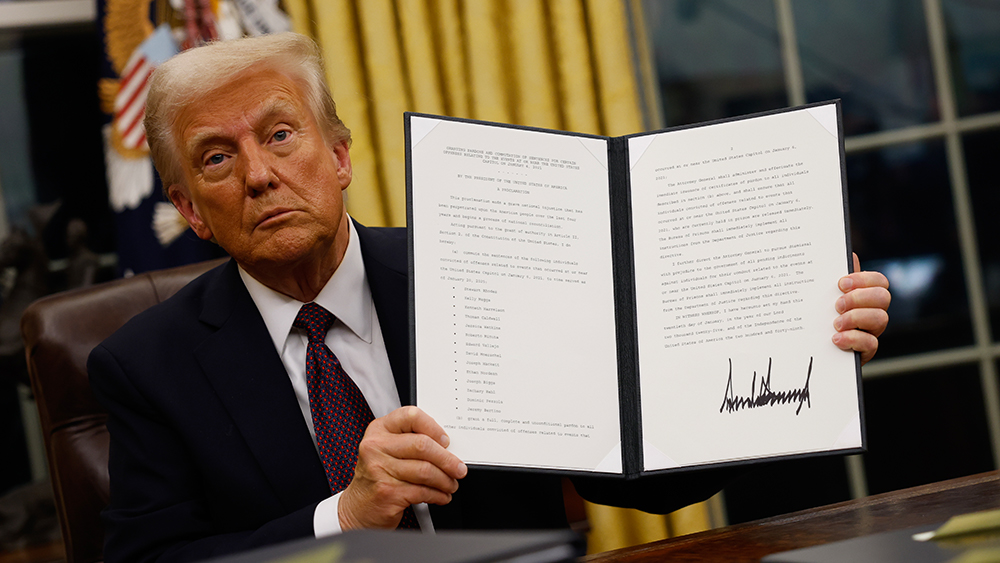
(NaturalNews) President Donald Trump signed an executive order halting foreign aid programs, including those deemed “unnecessary,” citing a $50 million…
Footage shows male senior swiftly strike ball in attempt to make goal, inadvertently hitting female player directly in mouth. A female high school lacrosse player [more…]

Use promo code “ALEX” when you sign up on Mug Club to get one month FREE of the network’s exclusive broadcasts, investigative reports, comedy specials [more…]

Suspect in black Lamborghini attempts rob man at Erewhon Market before shooting him in street, police say A man was shot during an attempted robbery [more…]

Watch & share this massive LIVE broadcast to get the latest on America’s border invasion, Mideast war, the NWO depopulation agenda & SO MUCH MORE! [more…]

Is this just another cycle, or is it the END? Martin Armstrong of Armstrong Economics published an article this week about the so-called Socrates program and how [more…]

“I assure you all options are open on the southern front. They can be adopted anytime.” Summary recap: Hezbollah Secretary-General Hassan Nasrallah’s speech went for [more…]

Putin orders planeloads of humanitarian aid to be sent to Egypt The Russian Ministry Emergency Situations said on Friday that it would send two aircraft [more…]

It is Tunisia’s duty to stand with the Palestinians, its president has said The Tunisian parliament on Thursday began discussing a bill that would define [more…]