





“This case could completely wipe out the ATF’s ability to create law and subvert congress, which would be a massive win for the Second Amendment.” [more…]


(NaturalNews) Putin sees the Riyadh talks as a positive step toward rebuilding U.S.-Russia relations. Trump criticizes U.S. financial support for Ukraine,…

(NaturalNews) In a disturbing turn of events, the popular social media platform Reddit is now allowing posts that openly call for a repeat of the violent French…
Starmer’s US visit comes amid rising tensions over free speech and the UK’s Online Safety Act.
Somehow a theory that multiple people are committing a crime together (a conspiracy) is discrediting.
FEMA’s $2.6M contract adds another layer to the government’s covert efforts to monitor and suppress online speech.
Kentucky’s Mitch McConnell (R), the longest-serving party leader in Senate history, announced his retirement Thursday afternoon to cheers and jeers (but
mostly cheers). The ailing senator has spent much of the goodwill he might have acquired in his twilight years as an elder statesman on fighting his own party’s popular president.
Thus far, his lonely resistance to Donald Trump has been ineffective, but don’t count the old man out just yet. He’s still very powerful. And now, he really has nothing to lose.
He may have been forced by colleagues to step down from leadership and forced by failing health to announce his coming retirement, but Mitch McConnell is still a powerful and dangerous player.
The past month has not gone as McConnell planned or how he’s used to things going. When he pledged at the American Enterprise Institute’s gala to resist the president’s foreign policy agenda from inside the Senate (just one week after Trump won the popular vote), he did not envision that playing out as a lonely protest vote from the back benches.
He almost always gets his way — and he rarely has to do his own dirty work. His ally Sen. Joni Ernst (R-Iowa) led the charge against Secretary of Defense Pete Hegseth. But the Republican resistance underestimated the swift and ferocious backlash. Ernst quickly backed down.
Next, Sen. Thom Tillis (R-N.C.), his closest ally, secretly funneled abuse allegations against Hegseth from a disgruntled former in-law. The White House responded with a charm offensive, and Tillis caved. He didn’t have the cojones to be the fourth decisive vote after all.
Then came former Rep. Tulsi Gabbard (D-Hawaii), nominated for director of national intelligence. Gabbard should have been a layup for the neocons, but when it came down to it, the president’s popularity won the day.
Now comes the fight over Elbridge Colby, who has been nominated to return for the second administration as undersecretary of defense for policy. Sen. Tom Cotton (R-Ark.) has taken the lead in opposing Colby, but if the vice president’s
public beatdown of other anti-Colby voices is any indication, the White House isn’t planning to let the Senate’s duty to “advise and consent” present as the power to control the executive branch.
The Republican resistance imagines it has that power — just ask Sen. Bill Cassidy (R-La.), whose
cringeworthy speech detailed the concessions he demanded to support Robert F. Kennedy Jr. for health and human services secretary.
But McConnell isn’t finished with Trump. He failed to block the president’s nominees, but as America’s least popular senator, he still wields significant influence. As head of the subcommittee on defense appropriations, he controls how funds are allocated — and for what. Expect him to use that power.
The Senate has surrendered many of its duties but still jealously guards appropriations. The chairwoman of the full appropriations committee is Sen. Susan Collins (R-Maine), a friend of McConnell from a state Kamala Harris won by more than seven points. You can expect both to work to tie the president’s hands on funding the Ukraine war, regardless of White House foreign policy or personnel.
He may have been forced by colleagues to step down from leadership and forced by failing health to announce his coming retirement, but Mitch McConnell is still a powerful and dangerous player. Remember: Trump’s first impeachment was over Ukraine funding. The
Grim Reaper’s time in the Senate may be coming to a close, but his battle is far from over.
Beltway Brief: Mitch McConnell’s secret war on Trump
Blaze News: The GOP whisper campaign against Tulsi Gabbard
The Federalist: McConnell’s retirement marks the end of the disastrous Bush era
Sign up for Bedford’s newsletter
Sign up to get Blaze Media senior politics editor Christopher Bedford’s newsletter.
Opinion & analysis, Politics
On Wednesday, Microsoft quietly announced a breakthrough that could change the world forever. No fanfare, no flashing sirens — just a casual revelation that it’s unlocked an entirely new state of matter. This isn’t science fiction. This is real. And if you thought the pace of technological change was overwhelming before, buckle up, because everything changed yesterday.
In science class, we are taught there are three states of matter: solids, liquids, and gases. Microsoft has allegedly developed a new class of matter, called “topological conductors,” that form the foundation of a new kind of quantum computing. The tech world has been chasing this for decades, and now, after nearly 20 years of research and billions of dollars, Microsoft has found the key.
This breakthrough isn’t just another incremental tech update — it’s a paradigm shift — and shifts like this don’t come without consequences.
Computing power is about to explode beyond anything we’ve ever imagined. Right now, we process information linearly — one step at a time. However, with quantum computing, an infinite number of calculations can be solved simultaneously. If today’s best supercomputers are like an Olympic sprinter, quantum computers are like teleportation — and we’re on the verge of plugging artificial intelligence into that system.
This week, Elon Musk’s AI system, Grok, released its latest update, and it’s already surpassing ChatGPT. I asked Grok how fast it learns new information, and it told me that in just 12 hours, it gains the equivalent of five to 10 years of human intellectual development. Imagine what happens when AI of this capacity is connected to quantum computing. The AI itself estimated that instead of advancing five to 10 years in 12 hours, it would leap 50 to 100 years in intellectual growth. Let that sink in.
We are looking at intelligence that will be unimaginably superior to the smartest human beings on the planet, accelerating at a pace beyond comprehension. It won’t be a matter of decades before AI outpaces human intelligence — but days — and we’ve just given it the keys to quantum power.
This is an event horizon, the moment after which nothing will ever be the same.
Tech elites, corporations, and governments are sprinting toward artificial superintelligence without a single serious conversation about what happens next. We already see AI systems manipulating public perception, influencing politics, and transforming industries. But what happens when an intelligence 1,000 times greater than any human starts making decisions for us? What happens when it controls entire economies, military systems, and information networks?
Microsoft’s announcement should have been headline news. Instead, it was a tweet, a YouTube video, a whisper in the background of the cultural noise. But this breakthrough isn’t just another incremental tech update, it’s a paradigm shift — and shifts like this don’t come without consequences.
We stand at the precipice of a new world. Quantum-powered AI will redefine everything — from the way we work, to the way we think, to the very fabric of reality as we understand it. This isn’t just an upgrade. This is the rewriting of the human experience.
Want more from Glenn Beck? Get Glenn’s FREE email newsletter with his latest insights, top stories, show prep, and more delivered to your inbox.
Glenn beck, Artificial intelligence, Quantum computing, Microsoft, Topological conductors, Grok, Chatgpt, Ai, Intelligence, Brain, Opinion & analysis
The new leadership at the U.S. Department of Justice has decided that President Donald J. Trump’s Jan. 20 pardon declaration covers both of the criminal cases lodged against Elias Nick Costianes Jr., setting the stage for his release from federal prison eight days after he turned himself in.
The DOJ’s new position on the matter, filed at the U.S. Court of Appeals for the Fourth Circuit, could have a ripple effect to eventually free at least three other pardoned Jan. 6 defendants — Jeremy Brown, Benjamin Martin, and Daniel Ball — who are still being held in federal prisons despite the president’s pardon actions.
‘He should immediately be released from incarceration.’
“The United States agrees that the President pardoned him, he should be immediately released from custody in connection with this case, his sentence should be stayed, and this Court should resolve his motion on an expedited basis,” Assistant U.S. Attorney David Bornstein wrote in a filing. “Because the President’s pardon has mooted Mr. Costianes’s appeal, the court should also vacate his judgment of conviction.”
Even though Costianes had appealed the order to report to prison on Feb. 12, the U.S. district court refused to give him an extension. He had not yet been assigned to a prison when word came from the DOJ on his emergency motion before the U.S. Court of Appeals.
The emergency motion was filed Feb. 12 by attorneys Carolyn Stewart and Roger Roots. The DOJ filed its response in the case on Feb. 19.
“The Government agreed that Mr. Costianes’ case falls under the Presidential Pardon, and that he should immediately be released from incarceration,” Stewart wrote in a reply filing on Feb. 20.
“He respectfully requests that this Court order that the U.S. Marshals and BOP immediately release Mr. Costianes from the Northeast Ohio Corrections Center (NEOCC) where he is presently incarcerated, vacate the judgment of the district court, moot the current appeal in this Court, and remand the case to the district court with instructions for dismissal.”
The DOJ’s position on Costianes’ release was made after consultation with department leaders in Washington, D.C.
Elias Costianes Jr. (right), pictured in the U.S. Senate Gallery on Jan. 6, 2021. Photo by U.S. Department of Justice
“After consulting with the Department of Justice’s leadership, the United States has concluded that the President pardoned Mr. Costianes of the offenses in the indictment,” Bornstein wrote. “This determination by the Executive is ‘conclusive and preclusive.’”
Costianes’ Maryland case grew out of a search of his Nottingham home authorized in Washington, D.C., as part of the DOJ’s investigation of Jan. 6.
During a search of Costianes’ home and property, agents found controlled substances including liquid testosterone, cocaine, and marijuana. They also found four firearms, two of which the FBI said were not registered to Costianes.
That led to a nine-count indictment for conspiracy to possess a controlled substance with intent to distribute, three counts of use of any communication facility to facilitate a drug felony, and three counts of distribution of a controlled substance.
Costianes agreed to plead guilty to the firearms charge, and U.S. District Judge James K. Bredar sentenced him to 366 days in prison.
Costianes’ Jan. 6 case was dismissed on Jan. 21 by U.S. District Judge Richard Leon after President Trump’s pardon declaration. Costianes had been charged with six criminal offenses from his time at the U.S. Capitol on Jan. 6.
Like Blaze News? Bypass the censors, sign up for our newsletters, and get stories like this direct to your inbox. Sign up here!
Politics
Once Trump starts calling someone a name, it sticks. Zelensky will forever be the Ukrainian dictator.
The Irish government scrambles to amend its stalled election misinformation law as even usually pro-censorship EU have concerns.
USAID has given $937 million to Serbia since 2001.
WhatsApp may face stricter EU regulation under the DSA as Meta reports 46.8 million active users, surpassing the VLOP threshold.

(NaturalNews) The PBS office solely dedicated to embracing the disputed ethos of diversity, equity and inclusion (DEI) â and its associated diversity officers…

(NaturalNews) Israeli Prime Minister Benjamin Netanyahu is reportedly planning a military strike on Iran’s nuclear facilities, with or without U.S. support,…
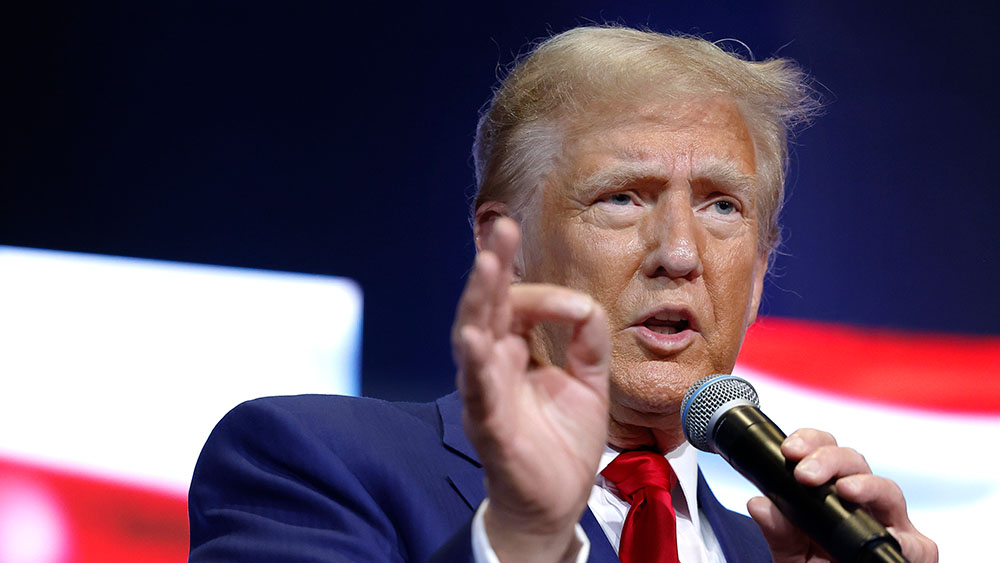
(NaturalNews) President Trump announced a potential 50 percent cut to military spending, aligning with his campaign promise of “no new wars.” Trump’s…

(NaturalNews) High-level investors and entrepreneurs are increasingly focusing on self-sufficiency, investing in agriculture and herbal medicine to prepare for…

(NaturalNews) The past 16 years have seen the overreach of political correctness under the Liberals, including the tearing down of Civil War statues and…

(NaturalNews) Wealthy nations are exporting toxic waste to less developed countries due to lax environmental regulations and lower disposal costs, perpetuating…

(NaturalNews) Senator Alex Padilla (D-CA) and Representative Joe Morelle (D-NY) have called for the reinstatement of officials at CISA placed on administrative…

(NaturalNews) California is considering state ownership of oil refineries as a response to the potential closure of several major refineries due to…
“This case could completely wipe out the ATF’s ability to create law and subvert congress, which would be a massive win for the Second Amendment.” [more…]

Elon Musk chimed in to question ‘how common’ this type of illegal activity is during American elections Bridgeport, Connecticut, the largest city in the state, [more…]

Chinese woman evades warrant for vehicular manslaughter after horror wreck caught on camera A Chinese woman fled back to her homeland after allegedly killing her [more…]

Downdetector has reported that several US banks are facing service disruptions on Friday morning. Update (1315ET): Fed Reserve Says ACH Error Impacting Customers Bitcoin literally [more…]

Footage shows male senior swiftly strike ball in attempt to make goal, inadvertently hitting female player directly in mouth. A female high school lacrosse player [more…]

Use promo code “ALEX” when you sign up on Mug Club to get one month FREE of the network’s exclusive broadcasts, investigative reports, comedy specials [more…]

Suspect in black Lamborghini attempts rob man at Erewhon Market before shooting him in street, police say A man was shot during an attempted robbery [more…]

Watch & share this massive LIVE broadcast to get the latest on America’s border invasion, Mideast war, the NWO depopulation agenda & SO MUCH MORE! [more…]