






“This case could completely wipe out the ATF’s ability to create law and subvert congress, which would be a massive win for the Second Amendment.” [more…]

Both of the primary suspects are also now under investigation for murdering two Swedish citizens in Ethiopia.
China’s Commerce Ministry said that while China will respect other countries’ right to negotiate with the US on an equal footing in response to President [more…]
Arkansas Republican Gov. Sarah Huckabee Sanders has signed a new law that will ensure religious adoption and foster agencies do not have to place children [more…]
The Trump administration is seeking the Supreme Court to “dissolve” its new ruling pausing deportation flights of Venezuelans to El Salvador under the Alien Enemies [more…]
Autism is an “epidemic” that “dwarfs COVID,” Secretary of Health and Human Services Robert F. Kennedy said in a radio interview on Sunday
Germany’s new ruling coalition wraps old censorship playbooks in shiny new language about protecting opinion and diversity.
Pope Francis has died aged 88

(NaturalNews) Oyster mushrooms (Pleurotus ostreatus) are prized for their savory flavor and health benefits, including anti-inflammatory, immune-boosting and…
(NaturalNews) A federal judge ruled that the EPA must release $20 billion in taxpayer funds frozen by Administrator Lee Zeldin, overturning the Trump…

(NaturalNews) The U.S. trade deficit fell for the first time in five months as imports from China and other partners grew slower than exports, aligning with…
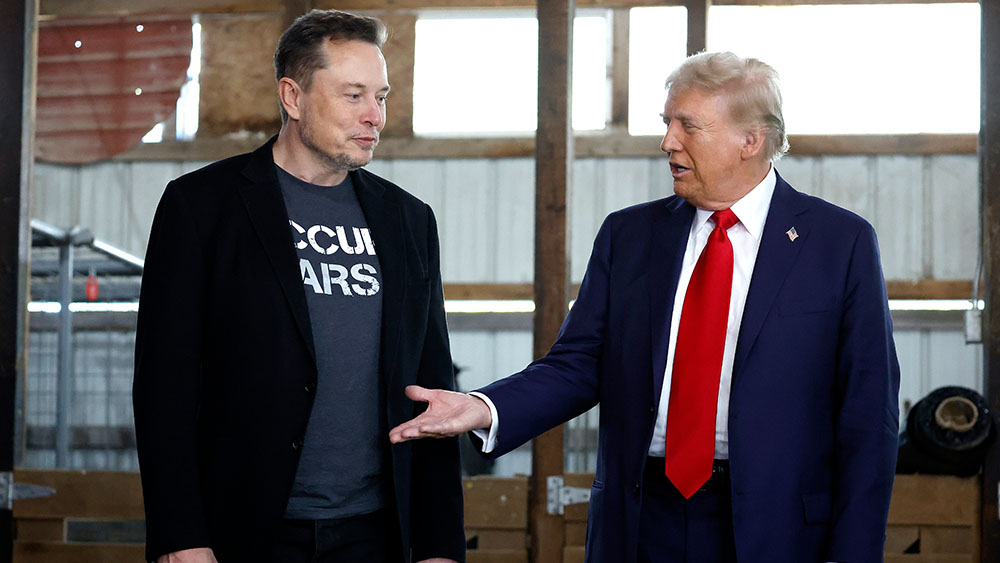
(NaturalNews) Department of Government Efficiency (DOGE) has eliminated $3.3 billion in federal contracts, delivering immediate taxpayer savings of $2.6…
(NaturalNews) President Donald Trump suggests tariffs, projected to generate up to $2.7 trillion, could replace federal income taxes, citing pre-1913 U.S….
(NaturalNews) President Donald Trump has exempted smartphones, computers and other electronic devices and components from the reciprocal tariffs imposed on…
(NaturalNews) President Donald Trump directed the Department of Justice (DOJ) to investigate ex-officials Christopher Krebs and Miles Taylor, accusing one of…

(NaturalNews) Scientists at Rice University and EPFL experimentally confirmed the superradiant phase transition (SRPT)âproposed by Robert Dicke in 1954âand…

(NaturalNews) A former FAA contractor and U.S. citizen admitted to spying for Iran, sharing 172 GB of classified aviation and energy sector data. Abouzar…
The University of Notre Dame may finally be on the verge of blocking access to pornography on its Indiana campus — and not a moment too soon.
When I was a student at Notre Dame in 2019, I met with then-President Rev. John Jenkins to urge him to adopt a campus-wide porn filter. Our student-led campaign had gained thousands of signatures and drawn national media attention, including coverage from Newsweek, the Daily Beast, and ABC’s “Nightline.”
With major corporations distancing themselves from the pornography industry, Notre Dame has even more reason to follow its students’ lead.
I explained to Father Jenkins, an affable priest of the Congregation of Holy Cross, how pornography fuels the trafficking of women and children. But he seemed more concerned about avoiding any attempt to control the behavior of male students who watch porn. His argument? That blocking pornography would deprive students of the chance to build self-control.
Six years later, that argument feels even more out of touch. A growing consensus now recognizes pornography not as a harmless personal vice but as a driving force behind the sexual exploitation of children and the trafficking of women. It’s also bad for the brain.
That change in understanding comes as a new generation of Notre Dame students has launched another effort to convince the university to act. Last month, students introduced a petition urging the university president “to take immediate action to promote a pornography-free campus.” According to the Irish Rover, a conservative student newspaper, more than 600 students have already signed the petition — an impressive showing at a university with only about 9,000 undergraduates.
Public opinion has shifted in recent years thanks in part to a groundbreaking 2020 New York Times article by columnist Nicholas Kristof titled “The Children of Pornhub.” In it, Kristof documented how Pornhub “monetizes child rapes, revenge pornography, spy cam videos of women showering, racist and misogynist content, and footage of women being asphyxiated in plastic bags.”
Kristof’s column shared the stories of young women whose abuse as children had been filmed and profited from by one of the most powerful pornographic websites in the world. Kristof concluded, damningly, that Pornhub “is infested with rape videos.”
The corporate world took notice. In response to Kristof’s exposé, Mastercard, Visa, and Discover all blocked payments to Pornhub to avoid liability for enabling child sexual abuse. Under pressure, Pornhub announced new age-verification policies last year. But the vast majority of pornographic websites still require no such safeguards. Child sexual abuse material remains rampant across “mainstream” platforms.
With major corporations distancing themselves from the pornography industry, Notre Dame has even more reason to follow its students’ lead. Other Catholic institutions already have.
Inspired by our 2019 efforts at Notre Dame, the Catholic University of America passed a student government resolution asking administrators to “prohibit access to the top 200 pornography websites through the campus network.” President John Garvey agreed and honored the request. Franciscan University of Steubenville and Christendom College also maintain similar pornography filters.
Now, with new leadership at Notre Dame, the odds of real action have improved. The Rev. Robert Dowd took office as university president in June.
When I was a student, I had the privilege of learning from Father Dowd. Unlike professors who treat students as interchangeable, Father Dowd made time to meet individually with everyone. His compassion wasn’t confined to the classroom — he also founded the Ford Program in Human Development Studies and Solidarity, which supports research aimed at alleviating poverty in the developing world. Standing against child sexual exploitation would be entirely consistent with both his academic and moral commitments.
But Father Dowd will face institutional resistance. Some administrators fear that blocking porn might make Notre Dame look provincial — unfit to compete with elite secular institutions. Others worry a filter might somehow impinge upon academic freedom.
Both fears are unfounded.
First, Notre Dame can lead the nation by taking a principled stand against an industry that fuels exploitation and abuse. Second, academic freedom can be preserved with basic accommodations. If faculty or students require access to pornography for legitimate research, they can ask Notre Dame’s IT department to lift the filter on their account.
And the technical hurdle? It’s minimal. John Gohsman, Notre Dame’s former vice president for information technology, told Students for Child-Oriented Policy that installing a filter “would be neither technologically difficult nor costly.”
I hope — and fully expect — that Father Dowd will heed today’s students and take meaningful action against the evils perpetuated by the pornography industry.
I’ll end where I began. In 2019, when Father Jenkins refused our request, I said this:
Pornography propagates sexual assault, contributes to the objectification of women, and advances the sexual exploitation of children. I call on Notre Dame to instead stand as a champion for women and children by enforcing the university’s official policy against using pornography on the campus Wi-Fi network.
That call is still waiting for a response. Now is the time.
Opinion & analysis, Notre dame, Pornhub, Pornography ban, Students, John jenkins, Robert dowd, Internet, Child sexual abuse, Academic freedom, Catholic university of america
“The building destroyed was used to ‘produce an ingredient in solid rocket motor propellant and is one of many in its production network.’”
Supreme Court Justice exposes banana republic behavior by ACLU lapdog justices.
Jesus is coming back — to the walls of the U.S. Merchant Marine Academy.
In a sharp reversal of the Biden administration’s campaign to scrub religious symbols from public institutions, Transportation Secretary Sean Duffy announced last week that a painting of Jesus covered up in 2023 would be restored to public view. The announcement drew cheers from merchant mariners gathered at the academy.
Under the previous administration, erasing Jesus from the walls was just the beginning. But that all changed the moment President Trump took office.
The painting, titled “Christ on the Water,” dates to the 1940s and was created to honor mariners lost at sea during World War II. But in early 2023, the Military Religious Freedom Foundation sent a letter to then-Transportation Secretary Pete Buttigieg, calling the artwork a “sectarian painting illustrating the supremacy of Jesus Christ” and demanding that it be removed as an unconstitutional endorsement of religion.
Naturally, Buttigieg complied. Joanna Nunan, the academy superintendent — whose biography boasted of her efforts to expand “diversity and inclusion” in the Coast Guard and Merchant Marine — ordered the painting covered.
U.S. Sen. Ted Cruz (R-Texas) and then-Rep. Jim Banks (R-Ind.) slammed Nunan for her “flawed understanding” of the First Amendment and called on the academy to keep the painting on display. At the time, academy midshipmen warned that “woke” ideology had “seeped into the school” — and that its spread had only accelerated under Biden and Buttigieg.
Duffy’s announcement marks a clear break from that era and shows just how dramatically things have shifted under President Trump.
Last week’s announcement isn’t the only recent move by the administration to defend America’s religious heritage.
Earlier this month, U.S. Secretary of Veterans Affairs Doug Collins announced that his office intervened to stop a speech code threatening chaplains at a Pennsylvania VA hospital.
The action came after First Liberty Institute and the Independence Law Center sent a letter to Collins on behalf of Chaplain Rusty Trubey. An Army Reserve chaplain, veteran, and former missionary, Trubey has served at the Coatesville VA Medical Center for nearly a decade.
In June 2024, as part of his regular duties, Trubey led a chapel service and preached from the first chapter of Romans. After the service, while cleaning up, he was approached by a VA police officer who said complaints had been filed about his sermon.
After the incident, the VA removed Chaplain Trubey from his duties, launched a months-long investigation, and threatened to mark his permanent record. Though the VA eventually dropped the reprimand, his supervisor pushed to impose a sermon review process and revise the Chaplain SOP and Performance Plan to limit what topics chaplains could preach on. Had those changes taken effect, chaplains could have faced punishment for preaching in accordance with their religious convictions.
Secretary Collins reversed course, stating clearly: “There is no national or local policy or standard operating procedure which inhibits Chaplain sermons. To the extent that there have been any proposed changes to any existing policy, those proposals will not move forward and have been rescinded.”
He emphasized, “It is undisputed and well-settled law that constitutional protections and the Religious Freedom Restoration Act safeguard statements made by all VA chaplains while delivering sermons in line with their ecclesiastical endorsers.”
Under the previous administration, erasing Jesus from the walls was just the beginning. Erasing faith from the pulpit soon followed. We can only imagine what the landscape would look like if the November election had gone the other way.
But that all changed the moment President Trump took office.
In his first days, Trump issued executive orders to restore religious liberty and end the weaponization of the federal government against political dissent — a tactic increasingly common in the left’s push to enforce its woke ideology. From the start, the administration made clear that faith would not be silenced.
That mission hasn’t let up. The fight to restore our first freedom has been relentless.
And to that, many Americans say amen.
Opinion & analysis, First amendment, Religion, Freedom of religion, Establishment clause, Sectarian, Pete buttigieg, Merchant marine academy, Sean duffy, Department of transportation, Ted cruz, Jim banks, Joanna nunan, Woke ideology, Woke military, Christ on the water, Romans, Chaplain, First liberty institute, Rusty trubey, Religious freedom restoration act

“This case could completely wipe out the ATF’s ability to create law and subvert congress, which would be a massive win for the Second Amendment.” [more…]

Elon Musk chimed in to question ‘how common’ this type of illegal activity is during American elections Bridgeport, Connecticut, the largest city in the state, [more…]

Chinese woman evades warrant for vehicular manslaughter after horror wreck caught on camera A Chinese woman fled back to her homeland after allegedly killing her [more…]

Downdetector has reported that several US banks are facing service disruptions on Friday morning. Update (1315ET): Fed Reserve Says ACH Error Impacting Customers Bitcoin literally [more…]
Footage shows male senior swiftly strike ball in attempt to make goal, inadvertently hitting female player directly in mouth. A female high school lacrosse player [more…]

Use promo code “ALEX” when you sign up on Mug Club to get one month FREE of the network’s exclusive broadcasts, investigative reports, comedy specials [more…]

Suspect in black Lamborghini attempts rob man at Erewhon Market before shooting him in street, police say A man was shot during an attempted robbery [more…]

Watch & share this massive LIVE broadcast to get the latest on America’s border invasion, Mideast war, the NWO depopulation agenda & SO MUCH MORE! [more…]