





Suspected provocateur specifically stated, ‘We’re here to storm the capitol. I’m not kidding.’ In a new mini-documentary diving into Jan. 6, investigative journalist Lara Logan [more…]


(NaturalNews) Over 200 guests exposed to potential bat colonies in a Wyoming lodge may need post-exposure prophylaxis. Rabies has a 100 percent fatality rate…
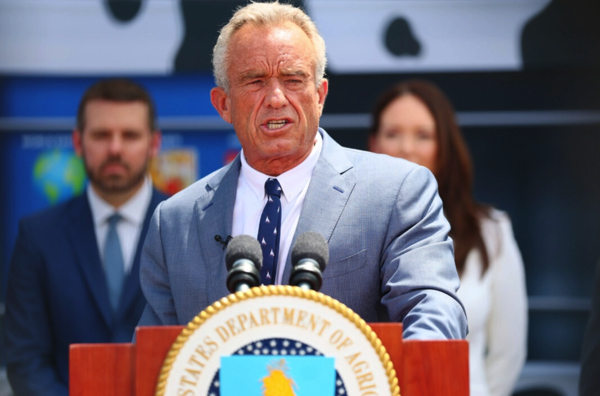
(NaturalNews) The White House postpones public release of its MAHA Commissionâs childhood health report, citing scheduling conflicts amid calls for systemic r…

(NaturalNews) Global Food Price Index hits highest level since February 2023, driven by surging vegetable oil and meat prices. Vegetable oils rise 7 percent …
President Trump’s response has been to prepare for it constitutionally by restoring law & order in DC.
The former House speaker and self-identified Catholic complained about Republican restrictions on transgender mutilation for minors, calling the crackdown ‘a sad thing.’
“If the Home Office is complicit in facilitating the movement of illegal migrants into the UK… that would be malfeasance in public office and legal [more…]
James Harvey arrested for chanting “stop the boats” and “deport” at July protest
Learn the truth the medical establishment does not want you to know.
Donald Trump on Monday invoked Section 740 of the District of Columbia Home Rule Act, placing the D.C. Metropolitan Police Department under direct federal control and deploying the National Guard to restore law and order. This move is long overdue.
D.C.’s crime problem has been spiraling for years as local authorities and Democratic leadership have abandoned the nation’s capital to the consequences of their own failed policies. The city’s murder rate is about three times higher than that of Islamabad, Pakistan, and 18 times higher than that of communist-led Havana, Cuba.
When DC is in chaos, it sends a message to the world that America is weak.
Theft, assaults, and carjackings have transformed many of its streets into war zones. D.C. saw a 32% increase in homicides from 2022 to 2023, marking the highest number in two decades and surpassing both New York and Los Angeles. Even if crime rates dropped to 2019 levels, that wouldn’t be good enough.
Local leaders have downplayed the crisis, manipulating crime stats to preserve their image. Felony assault, for example, is no longer considered a “violent crime” in their crime stats. Same with carjacking. But the reality on the streets is different. People in D.C. are living in constant fear.
Trump isn’t waiting for the crime rate to improve on its own. He’s taking action.
Trump’s takeover of D.C. puts the “broken windows theory” into action — the idea that ignoring minor crimes invites bigger ones. When authorities look the other way on turnstile-jumping or graffiti, they signal that lawbreaking carries no real consequence.
Rudy Giuliani used this approach in the 1990s to clean up New York, cracking down on small offenses before they escalated. Trump is doing the same in the capital, drawing a hard line and declaring enough is enough. Letting crime fester in Washington tells the world that the seat of American power tolerates lawlessness.
What Trump is doing for D.C. isn’t just about law enforcement — it’s about national identity. When D.C. is in chaos, it sends a message to the world that America is weak. The capital city represents the soul of the country. If we can’t even keep our own capital safe, how can we expect anyone to take us seriously?
RELATED: Trump to DC: Public safety isn’t optional
O2O Creative via iStock/Getty Images
Anyone who has visited D.C. regularly over the past several years has witnessed its rapid decline. Homeless people bathe in the fountains outside Union Station. People are tripping out in Dupont Circle. The left’s negligence is a disgrace, enabling drug use and homelessness to explode on our capital’s streets while depriving these individuals of desperately needed care and help.
Restoring law and order to D.C. is not about politics or scoring points. It’s about doing what’s right for the people. It’s about protecting communities, taking the vulnerable off the streets, and sending the message to both law-abiding and law-breaking citizens alike that the rule of law matters.
D.C. should be a lesson to the rest of America. If we want to take our cities back, we need leadership willing to take bold action. Trump is showing how to do it.
Now, it’s time for other cities to step up and follow his lead. We can restore law and order. We can make our cities something to be proud of again.
Opinion & analysis, Donald trump, Glenn beck, Glenn beck trump, Crime, Federal law, Home rule, Washington dc, Homicide, Violent crime, National guard, Police, Murder rate, Islamabad, Havana, Cuba, Statistics, National interest, Broken windows, Rudy giuliani, New york city, Law and order
A shield for reporters on paper, it hands governments the pen to rewrite the rules.
The statement was one of the most provocative heard in a while.
The complainants claim an X post by the PVV leader uses “Nazi-era propaganda tactics” to “vilify minorities.”
There is a quiet moment that precedes a sea change, the moment before a long-held secret becomes common knowledge. In the early 2020s, the most advanced artificial intelligence felt like a private language spoken only within the glass walls of a few corporate citadels. It was a kind of digital Latin, its syntax guarded by a technological priesthood. We, the public, were given translations through polished interfaces, clean API calls that delivered answers like pronouncements from an oracle, their inner workings a mystery. There was power in the control of access.
Now, the walls are being dismantled, not by force but by a deliberate act. The source code of many new AI models, along with the weights that define their functioning, are being posted on the internet for anyone to download. Power once consolidated is being atomized, shifted from the hushed cathedral of proprietary knowledge to the noisy and chaotic bazaar of open access. The central question is no longer what these models can do, but who gets to control them now.
What these open models offer is not just access but agency.
This change did not begin in a vacuum. The impulse is a familiar one in the history of knowledge. It echoes the 17th-century pivot to open science, when the Royal Society championed the sharing of discoveries over the alchemist’s secrecy, arguing that progress accelerates when methods are laid bare for verification and extension. It carries the DNA of the open-source software movement, which proved that a sprawling, decentralized community of volunteers could build something as robust and essential as Linux, an operating system that quietly came to run the world’s servers, eclipsing the proprietary systems of its time. AI may now be approaching a “Linux moment,” the inflection point where open, collaborative development overtakes the closed, top-down model.
Consider the artifacts of this new age. In August 2025, OpenAI, a name once synonymous with the most advanced and secretive models, released two of its own, fully open. One, a 117-billion-parameter model called gpt-oss-120b, was engineered with such efficiency that it could run on a single high-end GPU, hardware one might find in a design studio or a gamer’s bedroom. Suddenly, a lone developer standing at his desk could run sophisticated, near-frontier-level tasks, untethered from the cloud. The oracle could now live at home. The second, a 21-billion parameter model called gpt-oss-20b, could run on a high-end MacBook, easily carried around in one hand. This was a deliberate distribution of power, an acknowledgment that centralized control had already begun to fray.
It was a necessary acknowledgment, because others were already forging ahead. A lean startup called DeepSeek, for a fraction of the cost of its corporate rivals, released a model in May 2025 that could rival the giants on mathematical and coding benchmarks. A university lab, previously priced out of using top-tier AI for its research, could now download a tool that approached the reasoning power of a GPT-4, fine-tune it on its own private data, and scrutinize its every logical step. The model’s “chain of thought,” kept secret in proprietary models, was now just text on a screen, visible for analysis.
RELATED: How AI is silently undermining Christianity from within
Photo by Nurphoto/Getty Images
From China, the technology giant Alibaba released its top-tier Qwen3 open-weight models in July 2025. A European hospital, wary of sending sensitive patient data to American servers, could deploy a powerful AI assistant entirely on its own premises, customizing it with local medical jargon. The fact that a Chinese open model could be used by Westerners to declare their independence from American tech companies scrambles the usual narrative of geopolitical competition.
What these open models offer is not just access but agency. To run a model locally is to be able to audit it, to probe its biases, to understand its failure modes. When researchers download an open model and find it produces an undesired behavior, they can often trace the behavior back to the data it was trained on. The model becomes a window into the vast, messy archive of human text it ingested, and we are all invited to look. A closed model is a mirror with a sheet over it: We see only the polished reflection the company wishes to present. The desire for transparency reflects a distrust of black boxes, whether they are dictating credit scores, prison sentences, or the news we read.
Of course, this distribution of power is not without its own anxieties. When a tool is available to everyone, responsibility becomes diffuse, a collective burden. The old defense of the cathedral was safety, the idea that only the priestly class could be trusted with such magic. The argument of the bazaar is that true safety comes from collective scrutiny, from a balance of power where the many can check the ambitions of the few. It is a bet on the self-correcting nature of a community over the presumed benevolence of a corporation.
We are at the beginning of a tectonic shift in our relationship with knowledge and creation. These models, built from the public commons of the internet, are being returned to it. The boundaries between the human creator and the machine collaborator are blurring, as individuals are now free to mold and fine-tune their own private muses, their own specialized assistants. The very meaning of intellectual labor is up for negotiation. The new vernacular of AI is being written, not by a single authority, but by a global, uncoordinated, and ceaseless collaboration. The results will be remarkable, unsettling, and more distinctly our own.
Tech, Culture
Zelensky seeks forever war.
After building a reputation for cutting federal jobs in Washington, D.C., the Department of Government Efficiency is now tied to an expansion of federal authority.
President Trump announced Monday he would take over Washington’s Metropolitan Police Department and deploy the National Guard — an unprecedented move that came less than a week after photos of a shirtless, bloodied 19-year-old former DOGE employee went viral. The president declared August 11 “Liberation Day” and vowed to end violent crime and homeless encampments in the nation’s capital.
Our nation’s capital should project security and order to the nation and the world. It must be made safe again.
Trump’s detractors immediately pointed out that violent crime, including shootings and homicides, has been falling in the district. They’re right — on paper. Violent crime is down 26% this year, according to the city’s own numbers. But those figures are under scrutiny after accusations that officials manipulated the data.
Homicides, which are harder to fudge, are down 12%: 99 killings through August 11 compared to 112 during the same period in 2024.
Numbers alone, however, can’t capture the lived reality. Having spent the last year of my 15-year career in D.C. at the city’s Office of Gun Violence Prevention, I spoke with residents desperate for change. One man told me he and his pregnant wife dove to the floor when a bullet smashed through their window. Another woman worked with neighbors to demand more police patrols. Their frustrations highlight the fact that crime isn’t just a local issue but a hyperlocal one.
One activist I met has kept a memorial wall for homicide victims in his apartment since the 1990s. Some of the kids he mentored, he said, cherished the photos and videos because they were the only images they had of their fathers. In D.C., more than 60% of murders happen in just two of the city’s eight wards — far from tourist landmarks and high-end retail stores. Last August, a Democrat council member from one of those neighborhoods called for the National Guard himself after a wave of shootings.
Yet, those communities — overwhelmingly poor and black — rarely drive the political conversation about crime. Conservatives, like progressives, focus on the violence and vagrancy near their offices, homes, and favorite restaurants. That’s not a criticism; it’s human nature.
Everyone wants to feel safe where they live, work, and visit. But people from places where one murder makes front-page news can’t easily grasp how easy it is to grow numb to constant violence and disorder.
RELATED: Legacy media’s bogus defense of DC’s safe-streets narrative crumbles under scrutiny
Photo by STEFANI REYNOLDS/AFP via Getty Images
The left has its own contradictions. Leftists had no problem with the FBI combing through a NASCAR garage when they thought driver Bubba Wallace had been the target of a hate crime. More than 90% of D.C.’s homicide victims are black, yet racial inequality in violent crime barely registers among self-described antiracists.
Likewise, in 2021, commentator Roland Martin demanded a federal crackdown on “white domestic terrorism.” But he didn’t explain how many murder victims in D.C., Baltimore, St. Louis, Memphis, Philadelphia, Atlanta, New Orleans, or Chicago were killed by skinheads or neo-Nazis.
Whether the federal takeover will reduce crime remains to be seen. Conservatives frustrated by the government’s inability to produce the Epstein files might be overestimating how quickly crime can be cleaned up. Real change will require coordination across every level of government.
Still, my hope is simple: that whatever is done in D.C. will make it safer for residents, workers, and visitors alike. Our capital should project security and order to the nation and the world. It must be made safe again.
Opinion & analysis, Washington dc, Donald trump, Crime rates, Violent crime, National guard, Homicide, Statistics, Department of government efficiency, Doge, Murder, Conservatives, Progressives, Defund the police, Poor, Black, Families, Victims

(NaturalNews) Prostate cancer is a significant health threat, affecting about one in eight men, particularly those over 50 and primarily targets the prostate gl…

(NaturalNews) Israelâs security cabinet has approved a plan to militarily occupy the entire Gaza Strip, starting with the seizure of Gaza City. While Israel a…

(NaturalNews) Arkansas Gov. Sarah Huckabee Sanders signed a “Memorandum of Understanding” in Israel to strengthen ties between the state and the country, callin…

(NaturalNews) Prominent exiled Ukrainian journalist Diana Panchenko’s YouTube channel (with over two million subscribers) was removed without explanation. She w…
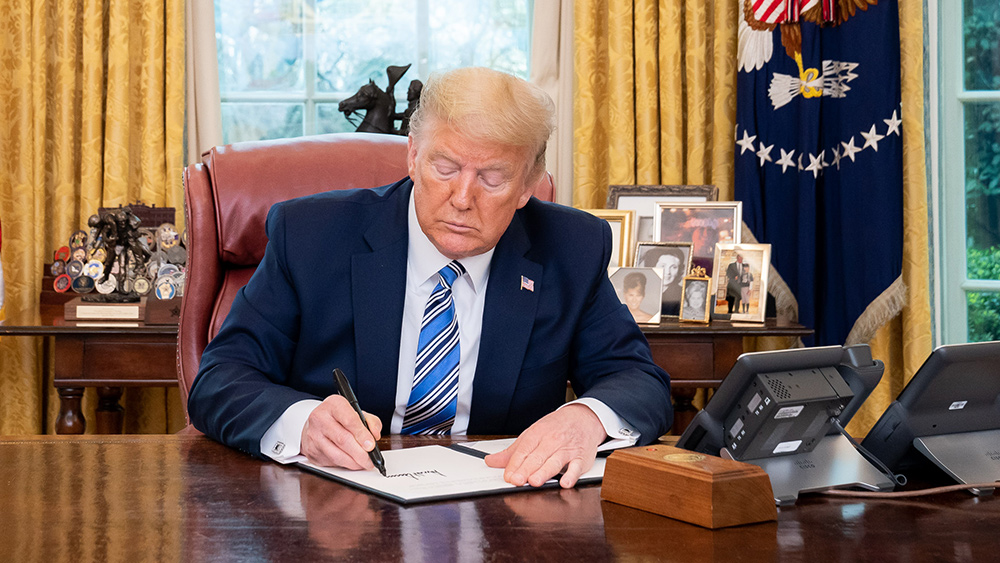
(NaturalNews) Nvidia and AMD agreed to pay the U.S. government 15 percent of their China-based chip sales (H20 and MI308 processors) to secure export licenses, …
Suspected provocateur specifically stated, ‘We’re here to storm the capitol. I’m not kidding.’ In a new mini-documentary diving into Jan. 6, investigative journalist Lara Logan [more…]

Mainstream media claims Obama-Biden partnership has only been happening for 5 months. Former President Barack Obama has been secretly advising the Biden administration for several [more…]

“This case could completely wipe out the ATF’s ability to create law and subvert congress, which would be a massive win for the Second Amendment.” [more…]

Elon Musk chimed in to question ‘how common’ this type of illegal activity is during American elections Bridgeport, Connecticut, the largest city in the state, [more…]

Chinese woman evades warrant for vehicular manslaughter after horror wreck caught on camera A Chinese woman fled back to her homeland after allegedly killing her [more…]

Downdetector has reported that several US banks are facing service disruptions on Friday morning. Update (1315ET): Fed Reserve Says ACH Error Impacting Customers Bitcoin literally [more…]

Footage shows male senior swiftly strike ball in attempt to make goal, inadvertently hitting female player directly in mouth. A female high school lacrosse player [more…]

Use promo code “ALEX” when you sign up on Mug Club to get one month FREE of the network’s exclusive broadcasts, investigative reports, comedy specials [more…]