





Is this just another cycle, or is it the END? Martin Armstrong of Armstrong Economics published an article this week about the so-called Socrates program and how [more…]

It’s not hard for BlazeTV host Mark Levin to dismantle Jimmy Kimmel’s narrative about Charlie Kirk’s assassination — because it was false — nor is it hard for him to dismantle the free speech outrage that followed his warranted suspension.
Levin points out that while Kimmel claimed the “MAGA gang” was “desperately trying to characterize this kid who murdered Charlie Kirk as anything other than one of them and doing everything they can to score political points from it,” all he really did was use ABC’s platform to lie.
“Well, first of all, that is a flat-out lie, and it is an attempt to politicize and exploit what took place, and people who love Charlie and his supporters trying to upset them, and he succeeded,” BlazeTV host Mark Levin says on “LevinTV.”
“Now, is that free speech? Is that constitutionally protected free speech under the First Amendment of the Constitution? There’s a difference between constitutionally protected free speech and just free speech,” he continues.
“The Kimmel suspension was never a battle over free speech or government control of speech. Kimmel was dropped because he’s a loathsome punk who made a highly inappropriate comment about the political assassination of Charlie Kirk. It is Charlie Kirk who was murdered because of his speech. Did Kimmel even talk about that? No. He lied,” he adds.
Levin also points out that ABC is a private company and has every right to fire its employees for what they say.
“I would ask you,” Levin says, addressing the audience, “most of you are employees, right? So if you say something that’s outrageous or inappropriate or something of that kind, and you’re fired, do you jump up and down and say, ‘Hey, my free speech rights! Hey, my free speech rights!’”
“You are careful to some extent because you know if you don’t have a governor on your mouth, you will be fired. Whether it’s your free speech or not, it’s irrelevant. Employers can and do fire employees for things they say,” he continues.
“The chairman of the FCC had no role in any of it, no matter what he said or didn’t say. He can’t even act on his own. He needs a majority of the commissioners,” he says, adding, “But he didn’t actually do anything. So there’s no First Amendment at issue, despite the best efforts to concoct one.”
To enjoy more of “the Great One” — Mark Levin as you’ve never seen him before — subscribe to BlazeTV — the largest multi-platform network of voices who love America, defend the Constitution, and live the American dream.
Sharing, Free, Camera phone, Video phone, Upload, Video, Youtube.com, Levintv, Mark levin, The blaze, Blazetv, Blaze news, Blaze podcasts, Blaze podcast network, Blaze media, Blaze online, Blaze originals, Jimmy kimmel, Charlie kirk assassination, Charlie kirk, Maga, President trump, Free speech, First amendment, Abc
So many slide decks and white papers promise a future of AI under human control, a project framed not as a technological sprint but as a long journey. The language is meant to reassure, a steady hand on the shoulder of a jittery public. Yet the very premise of the journey implies a certain departure, a recognition that the systems we are building now operate at a speed and complexity that have outstripped our capacity to easily oversee. One might nervously wonder whether the center will hold.
One answer to this predicament is “interpretability,” a technique for examining an AI model to figure out why it did what it did. It’s the equivalent of reading a plane’s flight recorder after a crash. But a system making thousands of autonomous decisions a second offers no time for such leisurely forensics. A failure may not be an event but a condition, a constant state of potential deviation.
The new thinking, then, is to move from forensics to architecture. The goal is to build in the oversight, to treat governance, not as a secondary analysis, but as a foundational requirement, an immutable audit trail that logs not just a model’s output but its entire lineage: the data it was fed, the model version that made the call, the key inputs that shaped its rationale. We are no longer merely watching the machine; we are building a watchtower.
At the heart of this new architecture is the “human-in-the-loop,” a concept whose neatness belies anxiety. The human, we are told, will shift from a passive reviewer to an active designer, engage in a continuous loop of governance that sets the boundaries and defines the goals. But the very act of depending on these systems can engender a state of cognitive offloading, a subtle atrophy of our own critical faculties. We are asked to be the system’s ultimate arbiter at the very moment the system is eroding the instincts required for the job.
The friction is everywhere. We see it in the laboratory, when a researcher at the University of Washington uses deep learning to design functional proteins that have never existed in nature, opening doors to novel medicines and biosensors. We see it in the game of Go, when a machine makes a move that defies centuries of human wisdom, a move of startling, alien creativity. The promise is one of discovery, of accelerating the scientific method. The possible reality is a “theory glut,” a condition in which the bottleneck shifts from ideation to validation. We find ourselves in a world that can generate hypotheses at a superhuman rate, but our capacity to test them, to ground them in the physical world, remains stubbornly, irreducibly human. We might drown in brilliant answers to questions we have not yet learned how to ask.
This dissonance echoes in the most intimate spaces of our lives. We are offered “digital twins,” virtual replicas of our own physiology, updated in real time, upon which a surgeon can rehearse a procedure in a risk-free environment. We are told that AI copilots will save the legal profession a great number of hours per year, freeing lawyers from the drudgery of document review to focus on the higher arts of deepening client relationships.
RELATED: Female avatar appointed as Europe’s first AI government official
Photo by SFOTO / Contributor via Getty Images
The narrative is one of liberation, of efficiency begetting connection. And yet, this reclaimed time exists within a system of escalating expectations. The Jevons paradox, a 19th-century economic observation, finds its modern footing here: As efficiency increases, so sometimes does demand. The two hours a sales professional saves each day are not banked for leisure; they are reinvested into the pursuit of higher quotas. The freedom from menial tasks does not lead to rest, but to the creation of new, more complex work.
And beneath it all, there is a persistent hum of vulnerability. The very transparency we engineer for control becomes a new attack surface. An adversary can engage in “data poisoning,” slipping malicious information into a training set to warp a model’s output in subtle, insidious ways. The system built for audibility becomes uniquely susceptible to a kind of attack that leaves no obvious trace, a hidden vulnerability that could lie dormant for years in a system that guides autonomous vehicles or calibrates antibiotic dosages. The solution, it turns out, has problems of its own.
The long journey points not toward a destination but toward a state of perpetual negotiation. The most critical constraint is not hardware or networking or power. It is talent. The crisis is human. The skill gap between the demand for those who can manage these systems and the available supply is the true bottleneck. The government may frame this challenge as a matter of national security, an imperative to maintain a competitive advantage. But it seems to be something more fundamental. A controllable AI future is not about building smarter machines. It is about the far more complex and uncertain project of building a more resilient and healthy human society, one capable of managing the strange and brilliant weather of its own creation.
Tech, Ai, Jevons paradox, Artificial intelligence
President Trump must pardon him ASAP, so he can expose the DC Metropolitan Police Department’s role in the fedsurrection!

(NaturalNews) Six varieties of Gina Marie Bakery cookies contained undeclared almonds and synthetic food dyes, prompting an urgent FDA recall. About five per…

(NaturalNews) “The Healthy Kitchen” combines integrative medicine (Dr. Andrew Weil) and culinary artistry (Rosie Daley) to promote food as foundational for phys…

(NaturalNews) YouTube has agreed to pay President Donald Trump and co-plaintiffs (including the American Conservative Union and Naomi Wolf) after suspending his…

(NaturalNews) The Trump administration is weighing Ukraine’s request for long-range Tomahawk missiles (1,500-mile range), which could dramatically escalate tens…
(NaturalNews) The National Security Committee of the Knesset (Israel’s parliament) approved a bill allowing courts to impose the death penalty on Palestinians c…
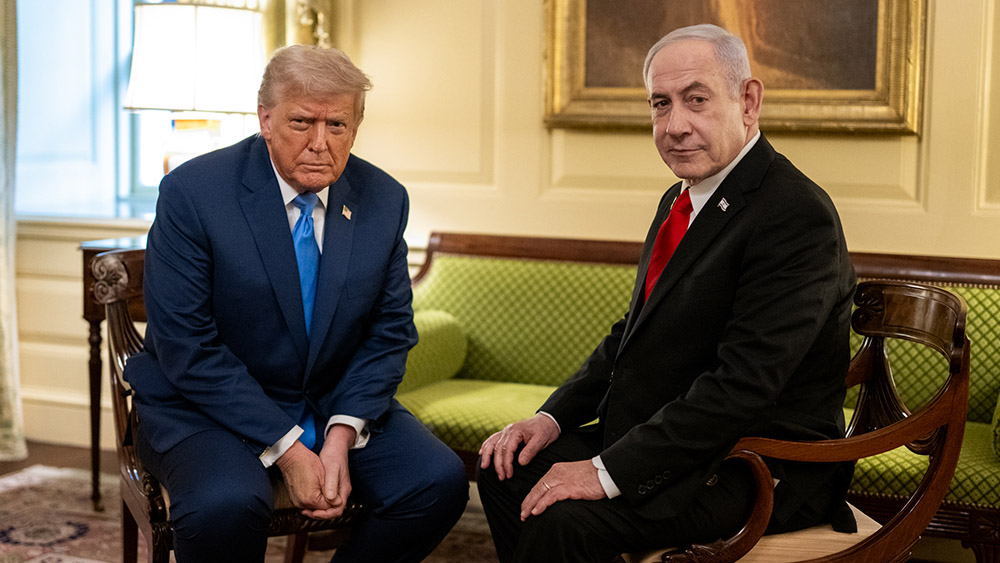
(NaturalNews) President Donald Trump and Prime Minister Benjamin Netanyahu announced a 20-point peace plan aiming to end the Gaza war. Trump called it a path to…

(NaturalNews) On Day 4 of the “A.G.E.S. Summit 2025 â Make Your Home Great Again,” Dr. Bryan Ardis explains why the average adult is exposed to 126-168 unique…

(NaturalNews) For decades, carrots have been hailed as the ultimate âeye food,â a belief rooted less in science and more in World War II propaganda. The British…
(NaturalNews) The Trump administration has expanded the Entity List to include subsidiaries of blacklisted companies, targeting Chinese entities like Huawei, Hi…
(NaturalNews) The U.S. government shutdown is the result of a partisan standoff between Republicans and Democrats, with each side blaming the other for the impa…
“We became the woke department, but not anymore!”
The femicide has sparked national coverage, as well as feminist marches, all while the family of the victim has condemned the failures of police and [more…]
Conservatives have long noticed a disturbing pattern: Hispanic illegal aliens appear again and again in drunk-driving cases. Recent news searches bring up multiple examples, some involving the deaths of children.
This summer’s tragedy in Wisconsin made the problem impossible to ignore — yet the corporate left-wing press tried to do just that. Two high school sweethearts, Hallie Helgeson and Brady Heiling, died when a drunk driver going the wrong way slammed into their car. Just weeks earlier they had gone to prom together.
Americans deserve more than platitudes and silence. They deserve honesty about the cultural, biological, and policy factors behind drunk driving.
The driver was Noelia Saray Martinez-Avila, a Honduran illegal alien who had racked up multiple drunk-driving charges. She lived in a sanctuary jurisdiction that shielded her from deportation. Only under the Trump administration’s renewed immigration enforcement did local authorities finally hand her over to ICE.
The Wisconsin case was heartbreaking, but it was not unique. In 2007, the Raleigh News & Observer published a rare report on the problem. A Mexican man admitted he thought he “drove better after a few beers” and that drunk driving was normal in Mexico. At the time, alcohol-related crashes caused by Hispanic drivers in North Carolina were three times higher than for non-Hispanics.
The national data confirms the trend. Hispanic drunk-driving rates are roughly double those of whites. Alcohol-use disorder is three times as common. More than a third of Hispanic alcohol-dependent users relapse, compared with 23% of whites.
Binge-drinking drives much of the danger. Hispanics are more likely than whites to consume large amounts of alcohol in one sitting. Forty-two percent of Hispanic drinkers admit to three or more drinks per day, compared to 30% of whites.
Mexicans, who make up half of the illegal alien population, show the highest risk. Mexican-Americans are three times more likely than whites to develop alcohol-use disorder. FBI crime data reported last year shows that Hispanics, 19% of the U.S. population, account for 30% of drunk-driving arrests and 44% of public drunkenness arrests.
In California, where Hispanics made up 37% of the population at the time, they represented 44% of DUI charges in 2012 (the latest I could find). In North Carolina, Hispanics were just 8% of the population but accounted for 18% of 75,000 DUI arrests in 2007.
New Mexico illustrates the deadly stakes. With a population that is half Hispanic, the state suffers nearly three times the national alcohol-related death rate. Five people die every day from alcohol. Before reforms in the 2000s, New Mexico’s DUI crash rate stood 70% higher than the national average.
The pattern reflects Mexico itself. In the United States, drunk drivers cause 31% of traffic deaths. In Mexico, the figure is over 70%. About 24,000 Mexicans die annually in alcohol-linked crashes — more than twice the U.S. toll despite the population difference. Until recently, most Mexican states had no legal blood-alcohol limits, and licensing often required little more than paying a fee.
Native populations face even steeper risks. In McKinley County, New Mexico, where the population is 80% Native American, the alcohol-related death rate is three times higher than the state average and ten times the national average.
Research points to genetic factors. Enzymes that mediate alcohol’s effects vary by ethnic group. Indigenous populations, exposed to alcohol only in the last 300 years, show far higher vulnerability. With Mexicans being heavily Mestizo — roughly 20% indigenous and 60% mixed indigenous (Mestizo) — the biological risk compounds the cultural one.
Given decades of national campaigns against drunk driving, one might expect attention to this ethnic dimension. Instead, the media downplay or ignore it. An America First lobbying group once tried to enlist Mothers Against Drunk Driving to raise awareness, but the effort went nowhere.
c_sorvillo via iStock/Getty Images
Academics sometimes excuse the problem by claiming Hispanic immigrants drink out of depression or isolation. Yet the biggest consumers are Puerto Ricans, not Mexicans. Cuban-Americans drink the least. Mexican women report the lowest rates of all, meaning the averages are driven almost entirely by men.
And claims of “racial profiling” ring hollow. Most offenders are caught at night, their identities confirmed by arrest records, not stereotypes.
Democrats dismiss these realities for the same reason they ignore illegal aliens’ broader lawbreaking: victimhood politics. They portray Hispanics as downtrodden and conservatives as cruel.
But the grief of families like the Helgesons and Heilings is not a talking point. It is permanent loss. It is trauma that echoes for generations.
Americans deserve more than platitudes and silence. They deserve honesty about the cultural, biological, and policy factors behind drunk driving. They deserve leaders who will enforce immigration law, reject sanctuary loopholes, and tell the truth about the risks that put their families in danger.
Opinion & analysis, Illegal immigration crime, Illegal aliens, Drunk driving, Drunk driving deaths, Mexico, Alcoholism, California, New mexico, Native americans, Hispanics, Immigration and customs enforcement, Ice, Sanctuary cities, Dui arrests, Media bias, Hallie helgeson, Brady heiling, Noelia saray martinez-avila, Genetics
Hollywood talent agencies are about to sign their first AI (non-human) actor-entity.
The AI entity seducing the film industry goes by the name of Tilly Norwood. Tilly is the creation of Eline Van der Velden, herself a human actress/comedian. Van der Velden seems to be more than happy to play the role of bridge between the film executive looking to save money and the technologist looking to provide cost-saving solutions in the form of digital representations on-screen. Van der Velden has sought for some years now to facilitate the corporate-technological gap within the film industry. Mission accomplished.
In the music industry, where life has never been the same since Napster, the ravages of tech are well known, and the response to AI reflects it. Spotify is rejiggering its algorithm to allow for select, curated AI music applications to flow on its platforms. Spotify has signaled that its policy revisions will target AI impersonation, spamming of the algorithm by AI slop producers, and, most notably, steps toward an international standards agreement regarding disclosure of AI content.
This role — creating fake people to act out what used to be a soulful calling for humans — we could call ‘non-human avatar technician.’
Spotify moving to increase its protections and analysis with respect to AI music is a great step. Maybe we’re winning. Somewhere in the corporate cloud are human ears listening to human voices crying for authenticity. Spotify’s latest forays into adjusting the relationships between these digital entities and humanity will provide an initial template for other corporations to build on. Wise human feedback must be incorporated as the process of adjustment proceeds.
Before we start slapping each other on the back, a nagging question: Why did the premier AI corporations roll out the creative stuff first? Why not remake HR, or paralegals? Maybe it’s too conspiratorial, but one wonders if it’s an example of “little Suzie, do you want peas or carrots?” Which is to say, if we avoid the AI ultra-slop in the arts, can we, human beings who live here on planet Earth among other humans, mitigate the creep toward the managerial, juridical, and religious AI slop flood? We better.
Conspiracy theorists of old used to talk about divide and conquer with reference to the unfolding forces (or secret agents) of history, and it’s hard to avoid seeing the way that the left is divided from the right with respect specifically to art and technology. In this latest reassessment, Spotify removed 75 million fraudulent songs. Not bad. This substantiates, to some degree, the company’s genuflection toward the sanctity of the art and the artist. Still, the company’s history and the pressures of making “number go up” suggest that audiences and critics should remain vigilant.
RELATED: A penguin avatar will be the new leader of a Japanese political party
Photo by Bloomberg / Contributor via Getty Images
Neko Case, the powerhouse PNW singer/songwriter (one given to voicing the occasional lefty political opinion), recently lamented of her latest album: “I had the privilege of making this record in a studio and maybe got the last advance anybody’s ever gonna get. And so I wanted to make sure all the sounds on the record were made by real people.”
We can imagine, and the discourse will soon provide, some lukewarm verbiage-gruel smeared over the only mildly interesting notion of AI fronting for an artist. “Puppeteer” simply wouldn’t do to substantiate the recursive pretension required to float a profession that (if it takes off) is just corporate and tech logic merging to feed the maw of public appetite for jejune psychic diversion. This role — creating fake people to act out what used to be a soulful calling for humans — we could call “non-human avatar technician” and stem the otherwise inevitable flow of false accolades.
There are many who say of this moment that AI and the intensity of investment ($500 billion from the U.S. government, as one example) suggest merely another financial bubble that, much like previous bubbles, is preceded by a massive fear of missing out. There’s some of that FOMO involved in this latest swing from Hollywood executives and music industry decision-makers. There’s a sense that they don’t know what’s next. Which isn’t surprising, because all such executives have ever known is how to buy true creative talent. Is AI true creative talent? Nope.
Hollywood needs to do what it can to limp along. Artists such as Case, despite whatever ideological or political differences they may have with Christians (and there are plenty), will need to look toward firmer spiritual ground if they hope to avoid total obliteration. For now, the audiences prefer human hands on instruments and genuine human vision in their storytelling. If the battle comes down to corporate costs vs. customer preference, however, we may need to begin looking at other options soon.
Tech, Culture
“Pacifism is so naive & dangerous, it ignores human nature & human history. either you protect your people & your sovereignty, or you will be [more…]
The measures give police officers greater powers to stop and search without suspicion, but police unions have previously dismissed the city’s weapons-free zones as ineffective.
Oracle founder Larry Ellison calls for unifying all data collected on individuals into one AI platform.

Is this just another cycle, or is it the END? Martin Armstrong of Armstrong Economics published an article this week about the so-called Socrates program and how [more…]

“I assure you all options are open on the southern front. They can be adopted anytime.” Summary recap: Hezbollah Secretary-General Hassan Nasrallah’s speech went for [more…]

Putin orders planeloads of humanitarian aid to be sent to Egypt The Russian Ministry Emergency Situations said on Friday that it would send two aircraft [more…]

It is Tunisia’s duty to stand with the Palestinians, its president has said The Tunisian parliament on Thursday began discussing a bill that would define [more…]

Suspected provocateur specifically stated, ‘We’re here to storm the capitol. I’m not kidding.’ In a new mini-documentary diving into Jan. 6, investigative journalist Lara Logan [more…]

Mainstream media claims Obama-Biden partnership has only been happening for 5 months. Former President Barack Obama has been secretly advising the Biden administration for several [more…]
“This case could completely wipe out the ATF’s ability to create law and subvert congress, which would be a massive win for the Second Amendment.” [more…]

Elon Musk chimed in to question ‘how common’ this type of illegal activity is during American elections Bridgeport, Connecticut, the largest city in the state, [more…]